
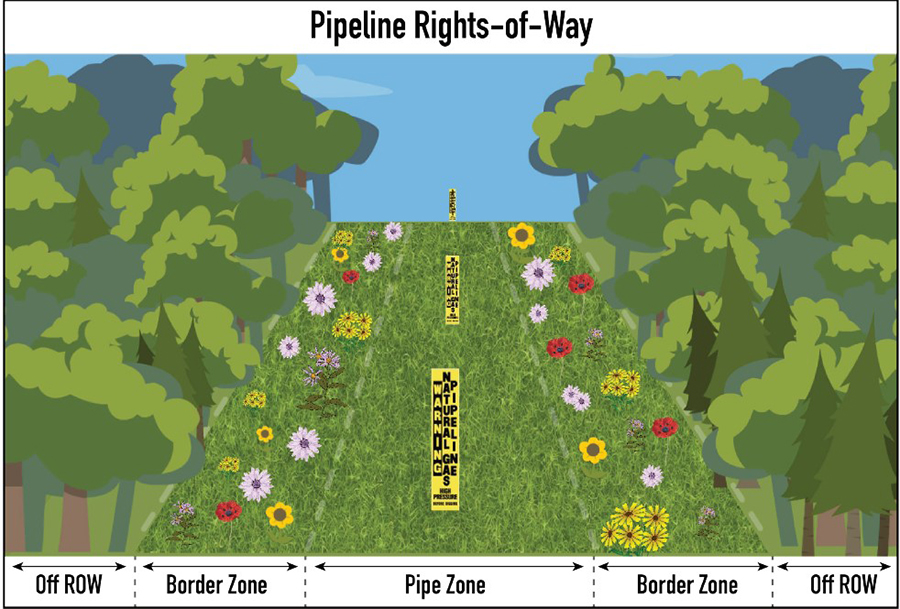
A Pennsylvania landowner may receive a letter saying a pipeline company intends to enter the property to inspect a line, clear trees, remove brush, repair a pipeline or replace equipment. The company may rely on an easement signed decades ago by a prior owner. The landowner may have little information about the pipeline or the limits of the right-of-way.
The company may have maintenance and access rights, but the answer is not found in the word “easement” alone. The recorded grant, its maps, the location and purpose of the proposed work, the operator’s safety duties, and the damage and restoration provisions all matter.
A landowner should take a maintenance notice seriously. Do not obstruct emergency work or create a safety hazard. At the same time, do not assume that a general reference to safety allows unlimited access, tree removal or use of any area the company selects.
Start with the recorded easement and every amendment
An express easement is interpreted from the language that created it. The document may grant rights to construct, operate, inspect, maintain, repair, replace, remove or change the size of one or more pipelines. It may also grant ingress and egress, allow tree and brush removal, or provide temporary workspace.
Older easements vary dramatically. Some identify a fixed width and centerline. Others describe the route generally. Some grant one line; others allow additional lines. Some contain advance-notice, damage and restoration duties. Others are brief and provide few protections.
Obtain the complete recorded instrument and review:
- the legal description and any attached map;
- the permanent easement width;
- the number and type of pipelines authorized;
- inspection, maintenance, repair and replacement language;
- rights to cut trees, brush or “obstructions”;
- ingress, egress and access-road language;
- temporary or additional workspace rights;
- notice and scheduling requirements;
- crop, timber, fence, drainage and other damage provisions;
- restoration standards;
- assignment and successor language; and
- termination, abandonment or release provisions.
The site’s explanation of permanent and temporary pipeline easements provides a useful starting point. The actual recorded agreement, however, controls the property-specific analysis.
Safety rules may require patrols and inspections
Federal pipeline-safety regulations require certain operators to inspect or patrol rights-of-way. For example, federal rules require gas transmission-line operators to maintain a patrol program that observes surface conditions on and next to the right-of-way for leaks, construction activity and other safety or operational concerns.
Those duties help explain why an operator may need access and a visible corridor. They do not, by themselves, rewrite the private easement. The operator’s regulatory obligation and its contractual property rights are related but separate questions. The proposed work should still be compared with the granted location, width, purpose and access rights.
Is the work inside the easement?
Ask the company to identify the easement boundaries and the proposed work on a map. A pipeline’s physical location is not always the same as the full legal easement. The company may also claim a temporary workspace or a separate access route.
If the work extends outside the mapped or described easement, ask what language authorizes the additional area. A company may argue that extra room is reasonably necessary for maintenance or safe equipment movement. Whether that position is correct depends on the grant and the facts.
The Pennsylvania Supreme Court’s Zettlemoyer decision shows why document language matters. The easement in that case granted broad rights to construct, maintain, repair and replace pipelines; rights of ingress and egress; and a specific right to cut and remove trees and obstructions. On those facts, the Court held that additional clearing for construction of another line was within the original parties’ intent and was reasonably necessary to the grant’s purpose. That decision does not create a universal right to clear beyond every pipeline corridor. It applies contract principles to a particular, broadly worded grant.
If a company proposes additional workspace, review the site’s page on the temporary easement area. The agreement should be checked for width, duration, permitted uses and restoration duties.
Can the company cut trees or remove vegetation?
A pipeline company may have a right to remove vegetation that interferes with inspection, access, safe operation or maintenance. But the scope of that right depends on the easement. Important questions include:
- Does the grant expressly mention trees, brush, undergrowth or obstructions?
- Is the vegetation inside the authorized corridor?
- Does it actually interfere with the line, visibility, access or safety?
- Is complete removal needed, or would trimming be sufficient?
- Does the company propose clearing outside the easement?
- Must the company provide notice or consult the owner?
- Who owns marketable timber after it is cut?
- What compensation and restoration does the agreement require?
Do not remove pipeline markers or begin digging, planting or construction within a right-of-way without appropriate utility-location and safety review. A landowner’s use of the surface generally cannot unreasonably interfere with valid easement rights. But the easement holder also should not treat the entire property as unrestricted workspace.
Tree removal may still create a damage claim
Even when maintenance activity is authorized, the agreement may require payment for physical damage to crops, timber, fences, roads, drainage or improvements. Document the property before work begins.
In Richards v. Sun Pipe Line Co., a Pennsylvania Superior Court case involving trees removed or trimmed for pipeline inspection and maintenance, the right-of-way agreement required payment for certain damages. The appeal addressed how property damage should be measured, not a general ban on maintenance clearing. The case is a reminder that authority to perform work and responsibility for resulting damage are separate issues.
Photograph and video the proposed work area, trees, fences, lanes, crops, drainage features and nearby improvements. Record the date, direction and location of each image. If timber is involved, consider whether a forester or appraiser should document species, size, condition and value before removal. Keep all notices, maps, crew information and communications.
Ask for a written work plan
Before nonemergency work begins, request a written description that identifies:
- the operator and contractor;
- the pipeline and project;
- the easement provision the company relies on;
- the dates and hours of entry;
- the access route and work limits;
- vehicles and equipment to be used;
- trees or vegetation to be removed;
- excavation, boring or soil disturbance;
- temporary workspace needs;
- fence, gate, livestock and crop protections;
- erosion, drainage and restoration measures;
- insurance and contractor responsibility; and
- the damage-claim contact and process.
If the proposed work changes the route or uses land outside the existing corridor, review the discussion of pipeline route location and route-change clauses. A new permission, amendment or workspace agreement should be evaluated before signing.
What if the company calls it an emergency?
A suspected leak, exposed line or other emergency requires a safety-first response. Stay away from the area, follow emergency instructions and call 911 when appropriate. Do not attempt to stop work at the site or approach equipment.
After the immediate danger is controlled, preserve the notices, photographs and damage records. Ask the operator to identify what occurred, what property was used, what repairs remain, and when restoration will be completed. Emergency access does not make documentation and later restoration unimportant.
Protections to negotiate in a new easement
Landowners reviewing a new pipeline agreement can address future maintenance before the dispute arises. Depending on the property and project, terms may include advance notice, defined access routes, mapped permanent and temporary areas, limits on tree cutting, landowner consultation, seasonal restrictions, crop and timber valuation, topsoil separation, drainage repair, fence and gate requirements, insurance, indemnity, restoration deadlines, as-built plans and a clear damage-payment process.
A pipeline right-of-way agreement review should evaluate both the company’s immediate construction request and the rights it may use years later for inspection, maintenance, repair, replacement and vegetation management.
Talk with a lawyer who represents Pennsylvania landowners
I have practiced law since 1995 and have more than 18 years of oil and gas experience. The Clark Law Firm, PC represents landowners and oil and gas rights owners only. We do not represent gas or pipeline companies.
If a pipeline company has sent a maintenance, tree-clearing, repair or access notice, we can review the recorded easement, maps, proposed work and damage provisions. The objective is to identify the operator’s existing rights, clarify the work limits, preserve appropriate landowner protections and address compensation or restoration questions without interfering with legitimate safety work.
Contact Attorney Douglas A. Clark at 570-307-0702.
The Clark Law Firm, PC
1563 Main St.
Peckville, PA 18452
This article provides general information, not legal advice for a particular easement, maintenance project, emergency or property dispute. Contacting the firm does not by itself create an attorney-client relationship.